
Subantarctic Islands
New Zealand's Remote Subantarctic Islands
Far south of New Zealand lies a chain of windswept islands where wildlife thrives in remarkable abundance. The Subantarctic Islands of New Zealand are among the Southern Ocean's most remote and protected wilderness areas, offering a rare opportunity to experience landscapes and wildlife that few travellers ever see.
Scattered across the cool temperate waters south and east of New Zealand, these islands are home to enormous seabird colonies, penguins, sea lions and unique plant life. Their isolation and strict visitor limits have helped preserve an environment that remains remarkably wild.
A New Zealand Subantarctic Islands cruise provides one of the best ways to explore this extraordinary region, with small expedition ships offering access to selected islands and opportunities for Zodiac excursions, wildlife watching and walks ashore.
Where Are the Subantarctic Islands?
The New Zealand Subantarctic Islands lie in the Southern Ocean to the south and east of mainland New Zealand, between New Zealand and Antarctica.
The region comprises six main island groups:
- The Snares Islands
- Auckland Islands
- Antipodes Islands
- Bounty Islands
- Campbell Island
- Macquarie Island
The first five groups are administered by New Zealand, while Macquarie Island is part of Australia. Together, these islands form an important network of protected Southern Ocean ecosystems.
Although they are sometimes described as being close to Antarctica, the Subantarctic Islands are geographically distinct from the Antarctic continent. They have a cooler temperate climate and their own unique ecosystems, making them a fascinating destination in their own right.
A Protected Wilderness
The Subantarctic Islands are recognised for their outstanding environmental importance. New Zealand's Subantarctic Islands are designated World Heritage sites and nature reserves, with strict controls on access to protect their fragile ecosystems.
Visitor numbers are highly restricted, and landing is not permitted on some islands. These limitations help preserve the islands as important breeding grounds for wildlife and ensure that human activity has minimal impact.
For travellers, this makes visiting the Subantarctic Islands a genuine privilege. There are no large visitor facilities, crowds or conventional tourist attractions. Instead, the experience is defined by remote landscapes, abundant wildlife and the feeling of being far from the modern world.
Wildlife of the Subantarctic Islands
The islands support an extraordinary concentration of wildlife. Their position in the Southern Ocean and highly productive waters provide ideal conditions for breeding seabirds and marine mammals.
Wildlife encounters can include:
- Albatrosses – Several species breed across the islands, including the spectacular Southern Royal Albatross.
- Penguins – Yellow-eyed, Snares Crested, Rockhopper and other penguin species may be encountered depending on the islands visited.
- New Zealand Sea Lions – Large colonies can be found around the Auckland Islands and other parts of the region.
- Seabirds – The islands support enormous breeding populations of petrels, prions, terns and other Southern Ocean birds.
- Fur Seals – Antarctic and New Zealand Fur Seals can be seen around selected islands.
- Unique plant life – Campbell Island and the Auckland Islands are particularly notable for their distinctive vegetation and spectacular mega-herbs.
The sheer density of wildlife is one of the defining characteristics of the Subantarctic Islands. On some landings, it is possible to encounter seabirds, penguins and seals within a remarkably small area.
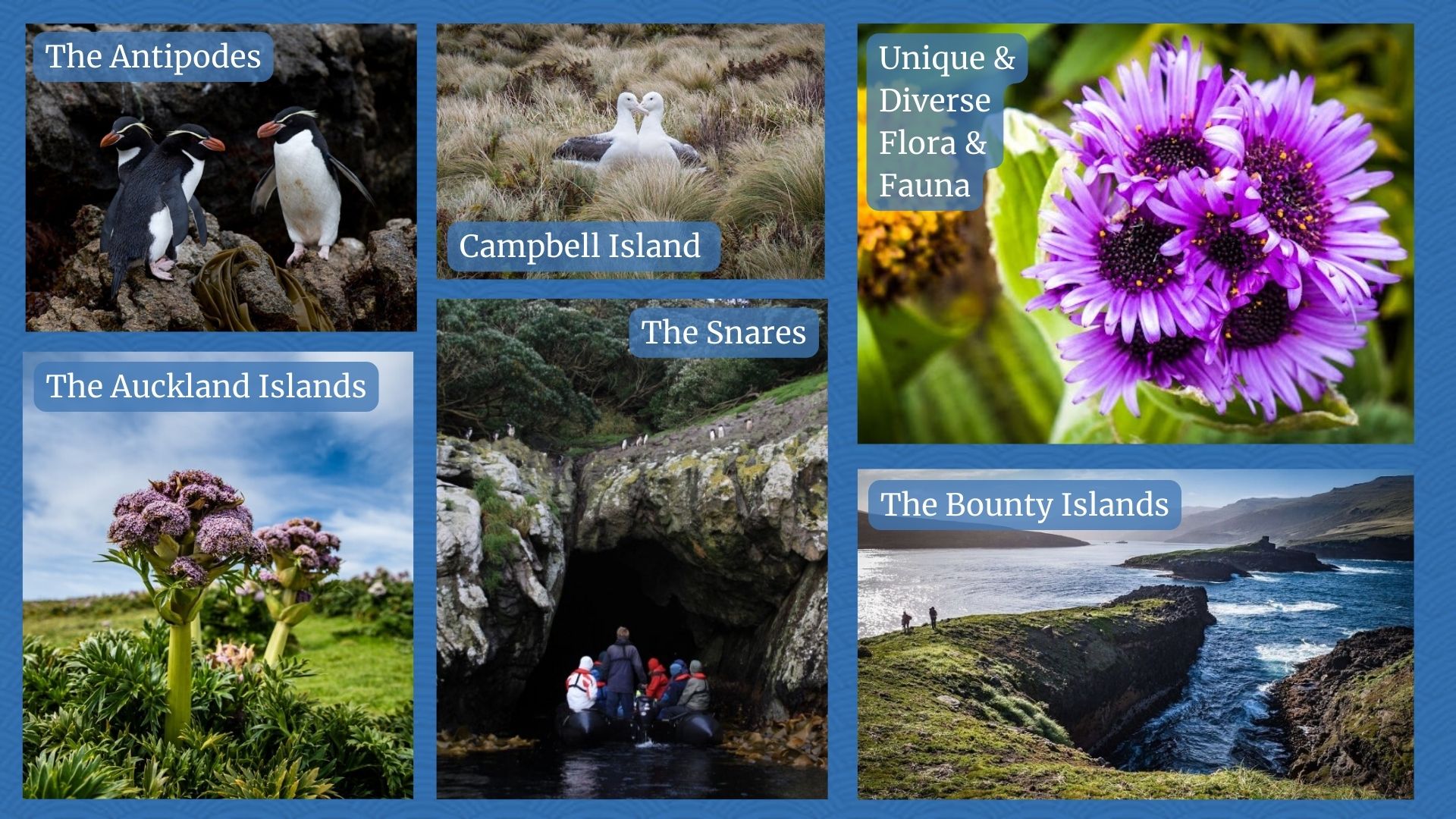
The Auckland Islands
The Auckland Islands are the largest of the New Zealand Subantarctic island groups. Their rugged coastline, steep mountains, sheltered harbours and dense vegetation create a dramatic environment for exploration.
Depending on conditions and landing permissions, expeditions may explore areas around Enderby Island and other accessible parts of the Auckland Island group. Enderby Island is particularly known for its wildlife, including New Zealand Sea Lions and Yellow-eyed Penguins, as well as its distinctive vegetation.
The islands also have a fascinating human history. They were visited by sealers and whalers during the 19th century, and several shipwrecks around the islands serve as reminders of the dangers faced by early visitors.
Campbell Island
Campbell Island is the southernmost of New Zealand's main Subantarctic island groups and is renowned for its dramatic landscapes and extraordinary plant life.
The island's remote location and exposed environment have created a distinctive ecosystem, including vast mega-herbs with unusually large leaves and flowers. These plants provide an unforgettable contrast to the rugged hills, cliffs and windswept coastline.
Campbell Island is also an important breeding ground for seabirds, including albatrosses and petrels. Walks across the island can provide opportunities to experience both its remarkable flora and abundant birdlife.
The Snares Islands
The Snares Islands lie approximately 200 kilometres south of Stewart Island and are among the most wildlife-rich islands in the region.
Landing is prohibited in order to protect the islands' fragile ecosystem, so expeditions typically explore the coastline by Zodiac. This provides an opportunity to observe wildlife from the water without disturbing the breeding colonies.
The islands are home to the endemic Snares Penguin, as well as large numbers of seabirds and New Zealand Fur Seals.
Macquarie Island
Macquarie Island lies further south and is administered by Australia. It is one of the world's most important sites for subantarctic wildlife and is particularly renowned for its enormous populations of penguins and seals.
The island is a major breeding site for King, Royal, Gentoo and Rockhopper Penguins, as well as Southern Elephant Seals and Antarctic Fur Seals.
Macquarie Island is included on selected longer expeditions through the Southern Ocean and may be combined with other Subantarctic Islands and Antarctic destinations.
Subantarctic Islands by Small Ship
A small expedition ship is the ideal way to explore the Subantarctic Islands. The ships can travel between remote island groups while Zodiac excursions provide opportunities to approach coastlines, wildlife colonies and areas that cannot be reached by conventional tourism.
Daily programmes are flexible and depend on weather, sea conditions, wildlife activity and landing permissions. Some islands can be explored on foot, while others are experienced from the water.
Walking opportunities range from relatively gentle trails to more demanding hikes across rugged terrain. Wildlife watching and photography are central to the experience, with opportunities to observe animals in their natural environment rather than in enclosed or managed facilities.
When to Visit
Subantarctic Islands expeditions operate during the Southern Hemisphere summer, when conditions are most suitable for exploration and wildlife activity is at its highest.
The main expedition season generally runs from November to March, although the exact timing varies between itineraries.
During the summer months, seabirds and penguins are breeding, seal colonies are active and the islands' distinctive vegetation is at its most vibrant. The longer daylight hours also provide more time for shore excursions and wildlife observation.
How Long Do Subantarctic Islands Cruises Take?
The length of a Subantarctic Islands expedition varies depending on the island groups included.
Shorter voyages may focus on the New Zealand Subantarctic Islands, while longer expeditions can combine the islands with Antarctica, the Ross Sea or other Southern Ocean destinations.
Because the islands are remote and weather conditions can affect landings, itineraries are designed with flexibility in mind. The journey itself is an important part of the experience, with days at sea offering opportunities to observe seabirds and marine life across the Southern Ocean.
A Rare Southern Ocean Experience
The Subantarctic Islands offer a different perspective on the Southern Ocean from the ice-covered landscapes of Antarctica. Here, rugged green islands, towering cliffs and windswept coastlines provide a backdrop for some of the world's most remarkable concentrations of wildlife.
For travellers looking for a small-ship cruise from New Zealand, a Subantarctic Islands expedition provides the chance to explore one of the country's least-visited regions. Strict visitor limits, protected ecosystems and the islands' remote location make every landing feel genuinely special.
A journey to the Subantarctic Islands is not simply a wildlife cruise. It is an expedition into a protected wilderness where the landscape, wildlife and isolation are the defining attractions.